


Hartford circus fire aerial, July 1944. Accessed from the Connecticut Digital Archive, July 2024.
With this year being the 80th anniversary of the July 6, 1944 Hartford circus fire, we wanted to take a look back to see how this tragedy affected the people of Windsor. Between 6,000 and 8,000 people sat under the Ringling Brothers and Barnum & Bailey tent on that hot afternoon when a fire broke out and began to spread rapidly. Officially, 168 people lost their lives and nearly 700 were injured when the gasoline- and paraffin-coated tent burned in less than 10 minutes.
Surprisingly, of the towns and cities surrounding Hartford, only Windsor suffered no fatalities from the fire, even though the Hartford-Windsor border lies just under 3/4 mile from the circus’s site at the present-day Fred T. Wish School on Barbour Street. Close enough to see and smell the roiling smoke, yet the people of Windsor buried none of their citizens.
Although fortunate in that sense, our town and its people were deeply affected by the tragedy. Much like the circus tent, which held three rings that day, Windsor’s story can be told in three parts: escaping, responding, and remembering.
ESCAPING
On July 7, 1944, The Hartford Courant reported:
“Four Windsor persons are known to have received slight injuries in the circus fire. Diane Lawrence [age 12] of 113 Maple Avenue, was burned about the right arm and received medical attention after being taken to her home.
Mrs. Thomas Brookman and her son Edward, 14, of Loomis Avenue, received burns about their backs. Mrs. Ray Martindale of Poquonock Avenue received burns about her hands, which she suffered from sliding down a pole. Others who escaped injury were Karl Fowler and his son Roger, Robert Cooper, Mr. and Mrs. Theodore Ford and their daughter, Alice.”
The Hartford Times added additional detail:
“Among the miraculous escapes from serious injury at the disaster was that reported by Ray B. Martindale. When the flames broke out, Mr. Martindale had his son Roger, 8, get onto his back and slide down a pole. Mrs. Martindale and Mrs. David E. Mather followed and the four escaped.”
The next day, under the subhead “Girls Escape Fire,” The Hartford Courant wrote:
“Three young girls who had been reported missing in the circus fire Thursday, returned home safely. The girls were Maxine Huntington, 9, of 306 Windsor Avenue; Jean Andrews, 13, of 254 Windsor Avenue; and Constance Carlton, 16, of Boston, visiting with the Andrews. […]
Maxine and Jean walked to their homes, arriving about 8 p.m., but were unable to tell where they had been. Meantime their parents had contacted hospitals, the Brown School, and had submitted identifications to authorities in the belief they might have been hurt or suffered a worse fate.”
Author Michael Skidgell gives further detail on the girls’ experiences in his book The Hartford Circus Fire: Tragedy Under the Big Top:
“The girls were seated high on the bleachers when the fire broke out, and all prepared to jump except Maxine, who froze. Constance delivered a hard slap to the face of Maxine, and they all jumped to safety.”
Skidgell adds that Richard Huntington, 15, Maxine’s brother, also survived the fire.
“Richard helped to carry injured and dead and loaded them into trucks. He went to the morgue to try to identify his missing sister, who survived the fire but was lost in the surrounding woods with her friends after escaping the burning tent.”
Many injured Windsor residents were awarded monetary settlements from a victim’s fund that Ringling Brothers and Barnum & Bailey was ordered to create. Among the settlements paid to Windsor citizens were:
- Edward Brookman, 37 Loomis Ave., $4,000
- Grace Brookman, 37 Loomis Ave., $12,000
- Shirley Snelgrove (formerly of Plainville), age 13, $25,000
Hospitalized for two months, Shirley Snelgrove’s extensive injuries included second- and third-degree burns to her back, legs, and both arms from her fingers to her shoulders. She also suffered from postural change due to burns, scars, shock, and depression; Shirley was orphaned in the fire.
“The Snelgrove family was celebrating daughter Shirley’s birthday by attending the circus. They sat opposite from where the fire started and went to the top of the bleachers when they saw the fire, but lost their nerve to jump. The headed for the main entrance, and became separated when Shirley wasn’t able to follow her parents over the animal cages. Shirley returned to the top of the bleachers, jumped, and was dragged out from under the tent alive. Shirley’s parents Olive and Edwin died under the tent.”—The Hartford Circus Fire
After Shirley recovered from her injuries, she lived with relatives in Windsor and graduated from The Chaffee School in 1949.
Diane Lawrence was 12 years old at the time of the fire. Diane’s diary for July 6, 1944 reads:
“I went to the circus. The Big Top burned down. I never want to go to a circus again. I have a burn on my arm.”

Twelve-year-old Diane Lawrence’s diary entry for the day of the fire. Courtesy of circusfire1944.com.
She recorded her memories decades later in an account published in The Hartford Circus Fire. Toward the end of her remembrance, Diane recalled her escape:
“Some memories are so vivid—such as the man who rushed past Dad and me, hurling chairs out of his way. … and my Dad—quiet, staunch and steady, like a rock in a rampaging river as all those people rushed by. … I used to be stoic, like him, but as I get older, I cry more easily. … It was an adventure then, everyone wanted to hear about it, see my scar—but now it’s frightening to realize just how lucky I was.”
RESPONDING
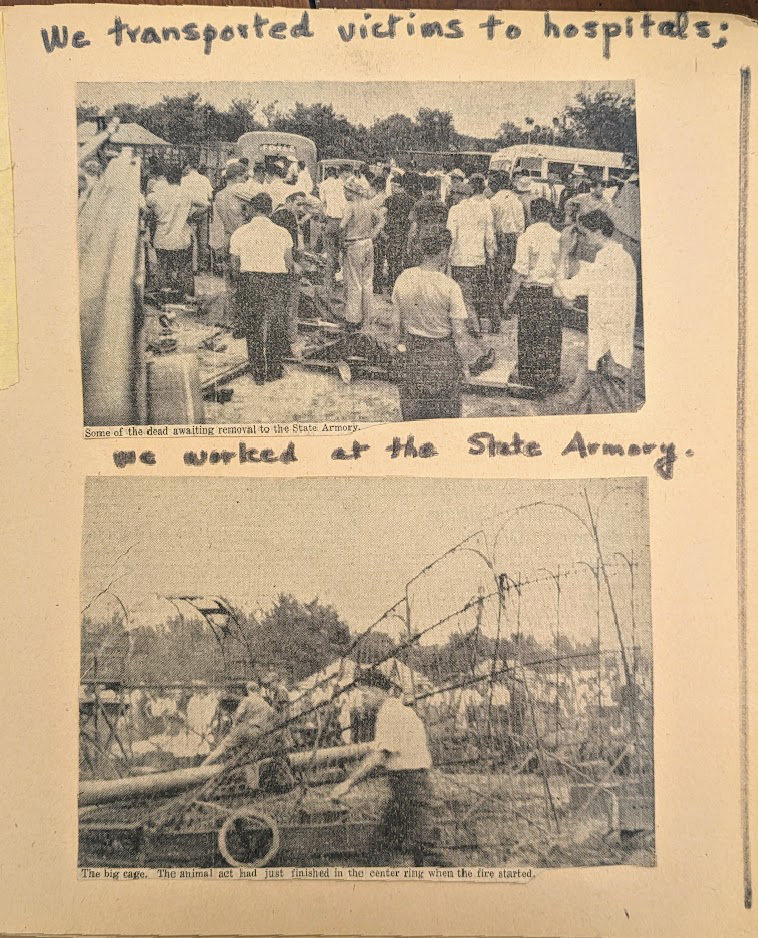
Newspaper clippings showing the work of the Windsor Motor Corps after the fire, from Martha Menard’s scrapbook, “A Windsor Woman During World War II.” WHS collections 1990.16.3.
Windsor’s immediate response to the fire was swift and meaningful. Because of Windsor’s proximity, our town’s emergency services were quickly called on to respond to the fire.
Beyond the usual emergency responders at the Windsor Fire Department’s Volunteer Fire Company and the police department, Windsor’s Women’s Motor Corps played an important part in saving lives during the fire. Established during World War I, this arm of the American Red Cross recruited women to drive ambulances, deliver supplies, and transport personnel and patients to posts and outings on the home front. Windsor’s Motor Corps was particularly active during World War II. Its activities were carefully documented in a scrapbook of photos, letters, and news clippings assembled by Lt. Martha Menard of Prospect Street, who was chair of the Civilian War Activities Division of the War Council.
On July 6, the Windsor Motor Corps escorted about two dozen wounded soldiers, who were convalescing at the military hospital at Bradley Field, to the circus. Diane Lawrence later recalled:
“As we walked in, we spotted my teacher from the previous year (6th grade), Mrs. Martha M. Menard, dressed in her Red Cross uniform, helping wounded servicemen into the bleachers adjacent to the entrance.”—The Hartford Circus Fire: Tragedy Under the Big Top
As reported in The Hartford Times:
“The trip of 25 wounded soldiers to the circus Thursday afternoon turned into a more harrowing experience than many of the men saw in actual combat. They were near the spot at which the fire started and all got out safely. Notwithstanding they are convalescing from wounds and would not be expected to do much strenuous service, each man on his way out picked up at least one child and some of them two, and got them to a place of safety. […] The Windsor Motor Corps, who had driven the soldiers to the circus, used their cars to assist in rescue work.”
On August 8, The Hartford Courant wrote:
“[T]he Windsor Branch of the American Red Cross received a letter from Herbert Duvall, special representative of the Ringling Brothers and Barnum & Bailey Circus, expressing ‘deep and sincere appreciation to the officers and members’ for their ‘splendid cooperation and assistance’ at the July 6 fire at Hartford.”
In her meticulous scrapbook, Lt. Menard documented the Motor Corps’s experiences at the fire, concluding with a page that contained two photos of the fire’s aftermath and this understated caption: “We transported victims to hospitals; we worked at the State Armory.”
The Armory was used as an emergency morgue; doctors, nurses, and volunteers—such as those from Windsor’s Motor Corps—spent days escorting distraught relatives through the building as they tried to identify the bodies of missing loved ones.
REMEMBERING
Engaged as they were with far-away news of World War II—and only a month after D-Day—the Windsor community came together quickly to mark this unexpected tragedy at its own doorstep. “Church Folk to Pray for Circus Dead” read the headline in a July 9 article in The Hartford Courant:
“Special prayers for the dead and injured of the circus fire disaster will be offered in all of the churches of Windsor, Wilson and Poquonock Sunday morning at the regular services.”
After the fire, six bodies remained unidentified and unclaimed. On Monday, July 10, six funeral homes, donating their services, prepared the remains for burial and drove the victims in a procession to Windsor’s Northwood Cemetery, where 200 mourners watched as the six coffins were interred.
A year later, on July 13, 1945, Windsor’s News-Weekly ran this article:
“Mrs. Joseph R. Russo and Mrs. Anthony DelGaudio, who are neighbors and friends, conceived the idea of decorating the graves of the six victims of the Circus Fire, who are buried in the Northwood Cemetery in Wilson. Accordingly on July 6, the first anniversary of the disaster, they interested about 15 children on Wilson Avenue in collecting flowers and flags. Hallgren Brothers, local florists, donated a large bunch of flowers also, and the little procession marched to the cemetery where they placed flowers and a flag on each of the six graves.”
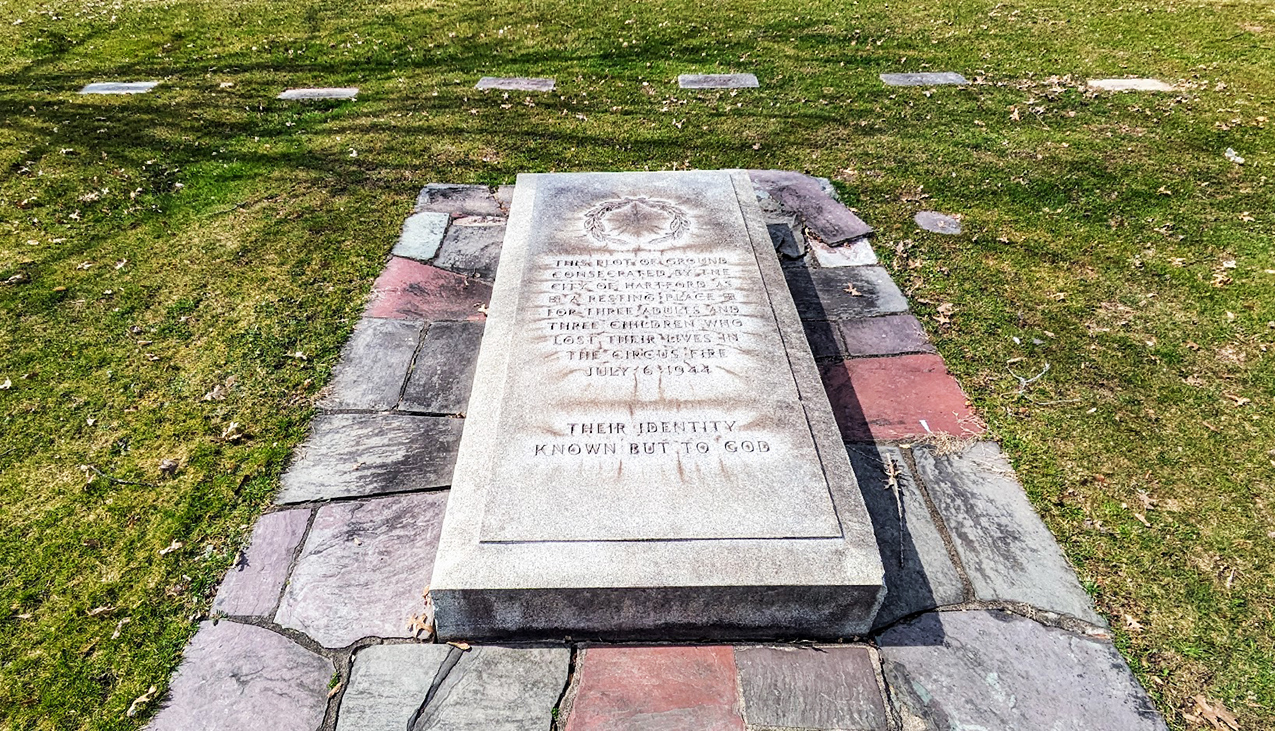
Graves for the unknown victims of the circus fire. Photo by Sarah Gilligan.
In August 1945, headstones were donated and installed, and that November a large stone slab commemorating the unknown remains—”Their Identity Known But to God”—was laid in place at the plot in Northwood Cemetery. And so, Windsor remains the home of the unknown victims, a little more than a mile from the site of the fire that took their lives.
By Sarah Gilligan, board member and volunteer
Thank you for this informative article about our town and the horrific Hartford Circus Fire. I’m proud that our town was so helpful during such a tragic event. My heart goes out to all who lost family members.